
Winn Parish Arrest Records and Court Charges
Winn Parish arrest records are created on the law-enforcement side. They may show arrest date, name, address or city, race, sex, age, arresting agency, booking status, and listed charges. The research found an official Winn Parish Sheriff's Office route for a weekly arrest report and an inmate lookup route, but both are JavaScript-gated in static inspection. Recent local reports show public arrest-report examples with charges such as failure to appear, warrant, disturbing the peace, DWI, possession, no seatbelt, open container, resisting arrest, and battery on a police officer.
Court charges after arrest are narrower and more formal. The District Attorney reviews the matter and decides what, if anything, to file in court. In Winn Parish, the Eighth Judicial District Attorney is R. Chris Nevils according to the official prosecutor roster. Once filed, the criminal charge record appears in the clerk-held court case. Booking detail belongs with sheriff or inmate records, while the full case file and outcome belong with Winn Parish criminal court records.
Find Winn Parish Arrest Records
Use a two-part search. First, check sheriff channels for arrest, booking, inmate, or weekly arrest report information. Second, check the clerk and court case channels for the filed charge and status. The Winn Parish Sheriff's Office site advertises Inmate Info, Submit A Tip, Make A Payment, School Resource Officers, news, events, and app features. The official mobile app is an alternate sheriff channel and may be easier to use than the JavaScript website for some residents.
- Check the Winn Parish Sheriff's Office inmate lookup or weekly arrest report route for booking-side information.
- Use the person's name, arrest date, charge label, or case number to ask the Winn Parish Clerk of Court about a filed charge.
- Confirm whether the DA filed a bill of information, amended a charge, declined a charge, or obtained an indictment.
- Read the case docket for charge status, plea, dismissal, warrant, disposition, or sentence entries.
- Use Louisiana State Police criminal-history channels only when a statewide background or right-to-review record is needed.
The official Winn Parish Sheriff's Office weekly arrest report route is the sheriff-side source assigned to this page.
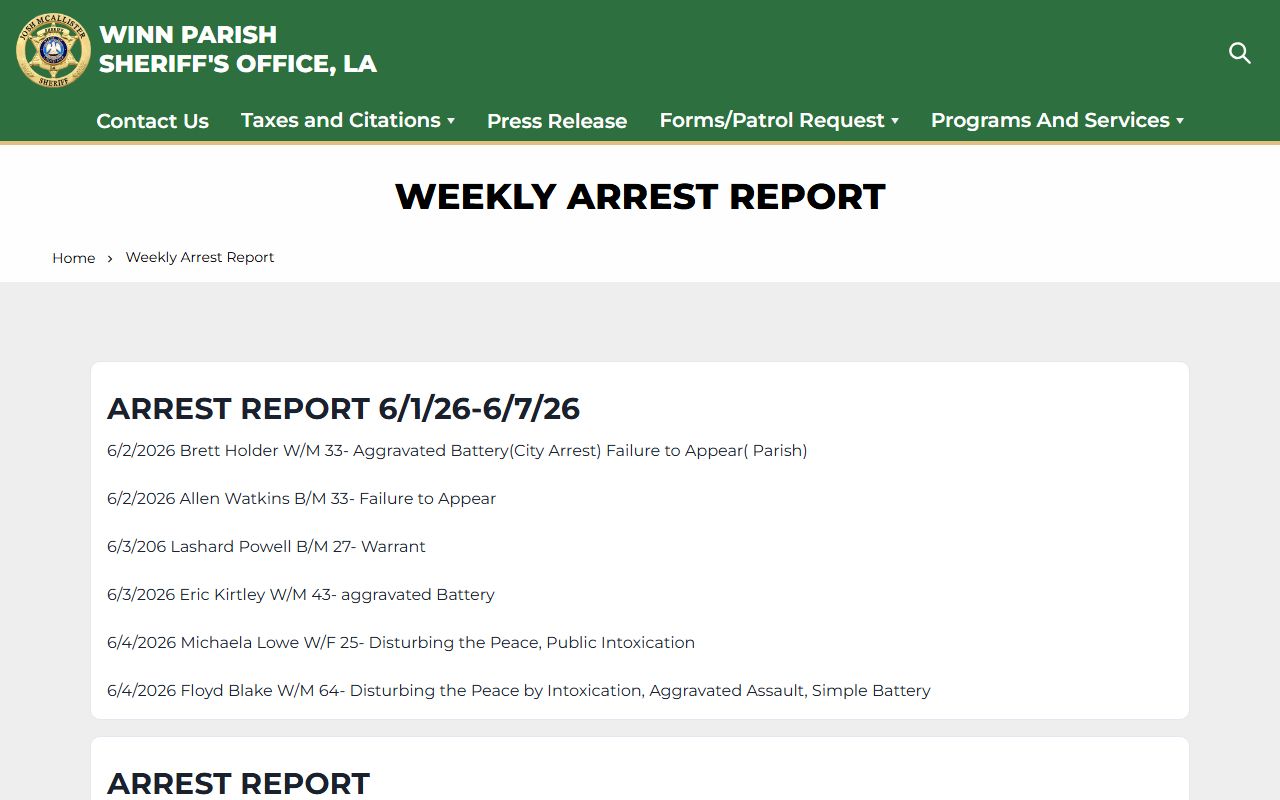
That sheriff route helps with arrest information, but it does not replace the clerk's charge, plea, and disposition records.
Charges After Arrest
A charge record begins when the prosecutor files or obtains a charging document. Louisiana criminal cases commonly use a bill of information filed by the DA. A complaint may start some matters, and an indictment comes from a grand jury. Each document can list one or more counts. The court file may later show amended, reduced, dismissed, or added charges, so the first arrest charge should not be treated as the final court outcome.
| Complaint | Information | Indictment | |
|---|---|---|---|
| Filed By | Officer or prosecutor, depending on setting | District Attorney | Grand jury |
| Common Use | Initial accusation or lower-level start | Many Louisiana district-court prosecutions | Serious felony or grand-jury matter |
| Record Location | Court or law-enforcement file | Clerk-held criminal court case | Clerk-held criminal court case |
Winn Parish Charge Status
Charge status can change as the case moves. A pending charge is still open. An amended or reduced charge means the prosecutor or court record changed the accusation. A dismissed charge did not result in a conviction on that count. A nolle prosequi entry means the prosecutor declined to continue that charge. A guilty plea, verdict, or sentence entry should be read against each charge, not against the arrest as a whole.
| Status | What It Means |
|---|---|
| Pending | The charge remains open and has not reached final disposition. |
| Amended or Reduced | The original charge changed to a different count, degree, or offense label. |
| Dismissed | The charge ended without a conviction on that count. |
| Nolle Prosequi | The prosecutor chose not to pursue the charge further. |
| Convicted or Pled Guilty | The record shows a plea or verdict that can support sentencing. |
Charges vs Convictions
Arrest records and charge records can show accusations that never become convictions. One arrest may list several alleged offenses, but the DA may file fewer, different, or more precise charges in court. A court charge becomes a conviction only after a guilty plea, trial verdict, or other conviction result. For employment, licensing, housing, or official use, the disposition matters as much as the charge label.
| Charge | Conviction | |
|---|---|---|
| Meaning | An accusation filed or listed after arrest | A court outcome after plea or verdict |
| May Change | Can be amended, reduced, added, or dismissed | May lead to sentence, appeal, or later expungement review |
| Where Found | Sheriff report, booking record, DA filing, or clerk case | Clerk case minutes, judgment, disposition, and sentence entries |
Charge Codes and Severity
Winn Parish charge records may use offense names, statute references, or plain-language charge descriptions. The research did not identify a Winn-specific charge-code table, so charges should be read from the actual sheriff report, DA filing, or clerk case record. Serious traffic crimes such as DWI may appear in both arrest information and court charges. Failure to appear can appear as a charge or warrant-related entry when a person misses court.
La. R.S. 44:3 is the Louisiana law-enforcement record statute assigned to this page.
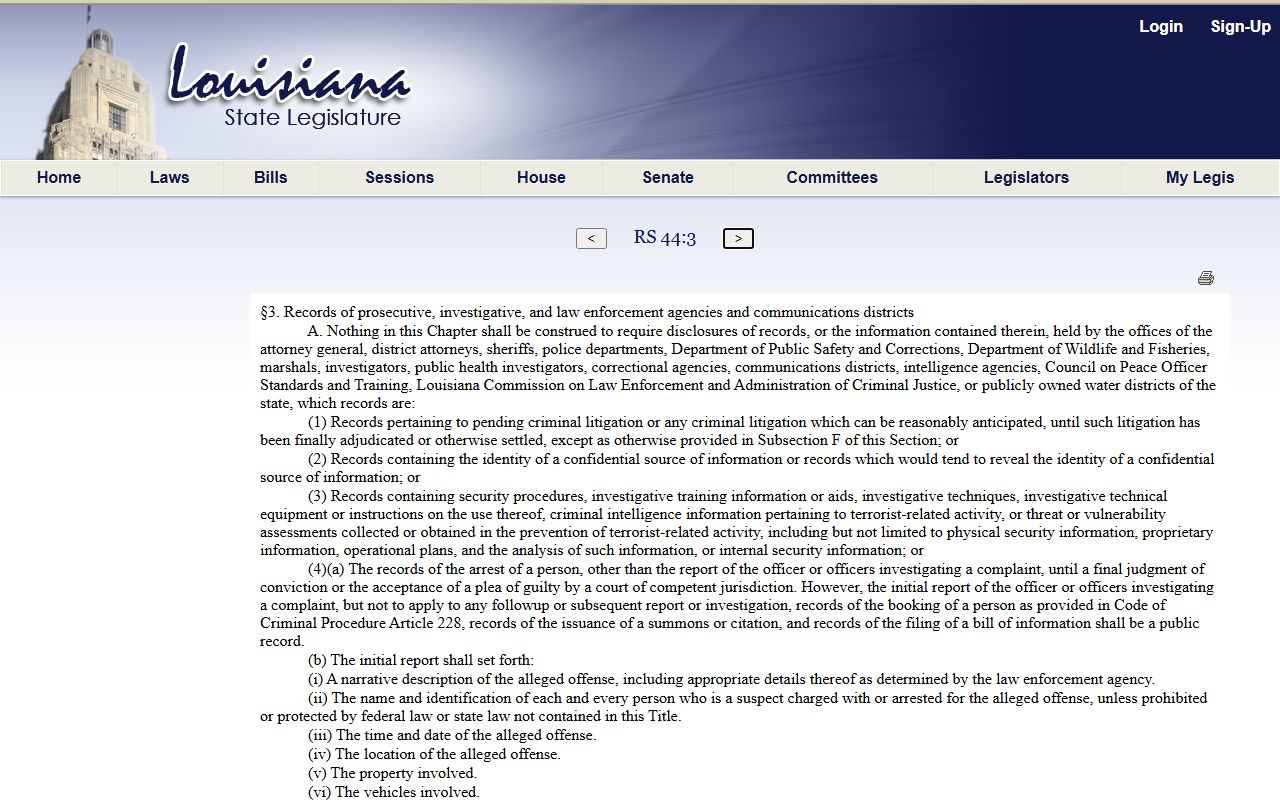
The statute explains why arrest, booking, bill-of-information, and investigative records do not all have the same public access rules.
Statewide Criminal Lookups
Statewide criminal-history access is separate from Winn Parish arrest records and court charges. Louisiana State Police BCII handles right-to-review and background-check channels, while local filed charges come from the clerk's criminal case file. The Louisiana sex offender and child predator registry is another separate state source. It should not be used as a general arrest search, but it can be relevant when the record type is registry status rather than a local charge docket.
The Louisiana State Police sex offender and child predator registry is a statewide public-safety registry source.
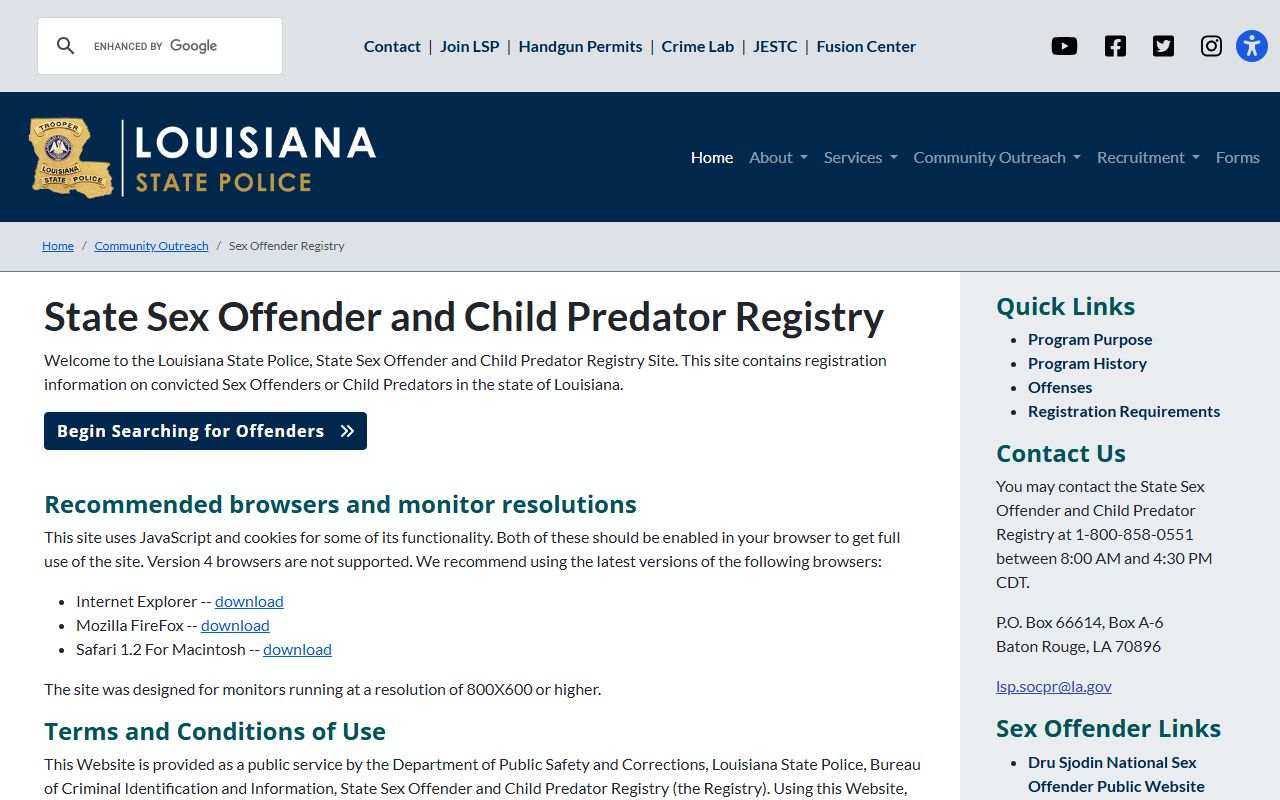
Registry records serve a different purpose from Winn Parish court charges and should be checked only when that specific status is relevant.
Sealed vs Expunged Charges
Some charge records are not open to the public. Juvenile court records are confidential in most cases, except traffic violations and express legal authorizations. Sealed records require court authority to view. Expunged records are removed from ordinary public access but are not destroyed under Louisiana expungement law. Law-enforcement and criminal-justice agencies may still access them when the law allows.
| Sealed | Expunged | |
|---|---|---|
| Public Search | Hidden or limited by court order | Removed from ordinary public access |
| Record Status | Still exists with access limits | Still exists for authorized uses |
| How to Review | Ask the court about authority or order requirements | Verify eligibility and order status with the clerk and court |
Access Arrest and Charge Records
Use the correct custodian. The sheriff is the starting point for booking, inmate, weekly arrest, tip, app, and law-enforcement request channels. The Clerk of Court is the starting point for filed charges, docket entries, pleas, dispositions, sentence minutes, and certified court copies. The District Attorney can explain prosecutor office functions but is not the clerk of the criminal case file. For emergency issues, the sheriff source directs residents to call 911.
8th Judicial District Attorney
119 West Main Street
Winnfield, LA 71483
318-628-2141
Fax: 318-628-2143
Winn Parish Clerk of Court
119 West Main Street, Room 103
Winnfield, LA 71483
318-628-3515
winncoc@suddenlinkmail.com
Note: A sheriff arrest listing is not proof that the same charge was filed or sustained in court.
Restricted Winn Parish Charge Records
Restricted records include active investigative files, sealed warrants, juvenile charges, protected personal data, victim safety information, expunged matters, and some records tied to mental-health or adoption proceedings. A public-records request should name the person, date range, record type, and requested format, but the custodian may withhold or redact material when Louisiana law or a court order requires it. When a charge status must be proven, request the minute entry, judgment, or certified copy from the clerk.
Important: Do not treat an arrest charge as a conviction without checking the final court disposition.